
Cantonese & Mandarin Popup Dictionary
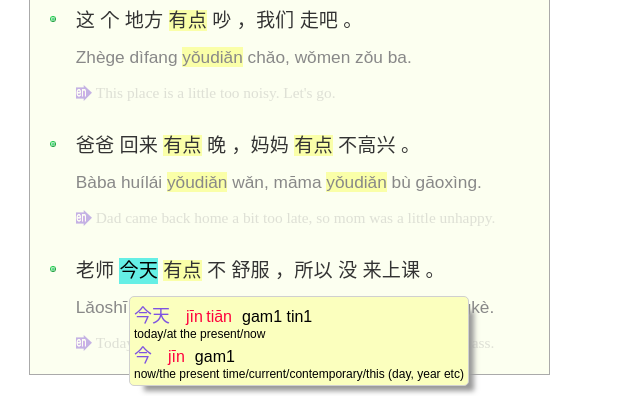
Chrome extension that displays Mandarin and Cantonese dictionary definition when hovering over text
Overview
One of the struggles with learning a language like Mandarin or Cantonese is quickly looking up characters in dictionaries. For me specifically, this required either struggling to recall the pronunciation, using OCR or manually drawing the strokes in a dictionary.
This problem has been solved in part thanks to Zhongwen, a dictionary that pops up a new window whenever you hover over a character or a word. Similar solutions exist for Cantonese.
However, I quickly ran into a problem when attempting to learn both languages: there is no dictionary that combines both. I got to work on refactoring some of the Zhongwen code to make it easier to add in a new language, and attempted to push the changes upstream . I did not get a yes or no response, and figured most that adding Cantonese would most likely expand the scope of the original extension outside of what the author had in mind for it - hence the fork.
Development
One of the first things I did was a refactor of the codebase to make it more readable while adding in support for the Cantonese dictionary, and presenting definitions from the now two different dictionaries. This was enough to get something out of the door back in 2020 and have it released.
Since then I have handled a few contributions , then I decided in 2024 to put the time in for a Manifest V3 migration. I decided to tackle it slowly by first building up a test suite as I go, and building it around all existing functionality, while bit by bit refactoring and migrating the extension.
First I built up simple unit tests around the not browser specific functionality - eg. searching in the dictionary, creating the dictionary, adding words to the word list etc. This moved the core of the code out of the browser and into specific classes/modules that could be tested separately.
Then Puppeteer could handle the end-to-end browser tests, as seen in this example. When run, the test cases could also be followed live to see any erroneous or quirky behaviour.
The tests gave me plenty of confidence that the migration is going well, and provided a nice base for any future contributions or stress-free dictionary file updates.
Audience
I did not expect my user base to be large - it is somewhat of an intersection between Mandarin learners and Hong Kong Cantonese learners (or, I should say, Cantonese learners who are familiar with Jyutping romanization). As of January 2026, the user base of the Chrome Extension is 650+ users and steadily growing.